Why Do Cats Slow Blink at You? What It Means
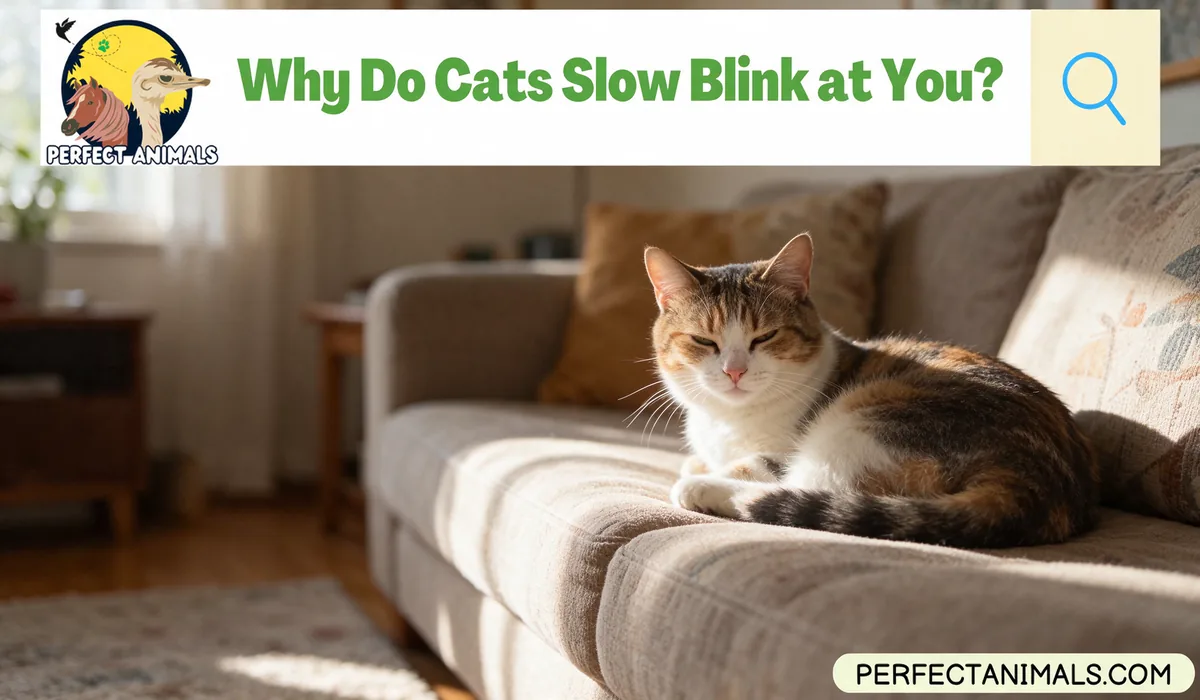
If your cat looks at you, gently narrows its eyes, and slowly closes them before opening them again, you may wonder, why do cats slow blink at you? Many cats use this relaxed eye movement during comfortable social interactions, and people often call it a feline smile. But the most accurate answer is more careful: a slow blink can be a positive signal, yet its meaning depends on the cat’s body language and surroundings.
Here is what slow blinking is, why it may communicate safety or trust, how to respond without pressuring your cat, and how to tell a relaxed slow blink from a sign of eye discomfort.
Why do cats slow blink at you?
A cat slow blink is a deliberate sequence of eye narrowing, half blinks, and a longer closing of the eyes. When a cat does this while its body is loose and its ears are in a neutral position, the gesture often appears during a calm, friendly interaction.
Closing the eyes briefly can make a cat look less threatening because it is not maintaining a hard, unbroken stare. Cats Protection describes slow blinking as a possible sign of comfort, affection, or trust, while also noting that the scientific evidence is limited and that context matters.
Is a cat slow blink the same as saying “I love you”?
It can be part of a positive relationship, but “I love you” is too exact a translation for every cat and every situation. A slow blink may show that a cat feels safe enough to soften its gaze around you. It does not prove that the cat wants to be picked up, petted, or approached.
Read the rest of the cat’s communication. A relaxed cat may have a loose posture, soft facial muscles, neutral ears, and a tail that is not lashing. A cat that is crouched, tense, hiding, flattening its ears, or trying to create distance may be stressed even if its eyes narrow briefly.
What does research say about cats and slow blinking?
A peer-reviewed study published in Animals examined slow-blink interactions in shelter cats. The researchers describe the sequence as repeated narrowing of the eyes followed by prolonged narrowing or closure. Earlier research found that cats were more likely to approach an unfamiliar person after that kind of eye-narrowing interaction.
In the shelter study, cats that responded to a person’s slow blink with more and longer eye closures were rehomed sooner. The researchers also found a trend suggesting that cats identified as more nervous around people could produce longer slow-blink responses. The authors therefore discuss a possible dual function: the behavior can appear in friendly, affiliative situations and in more submissive or anxious contexts.
That result is useful because it prevents an overly simple rule. A slow blink is often encouraging, but it should be interpreted together with the cat’s posture, the environment, and what happens next.
Should you slow blink back at your cat?
Yes, you can try it gently. Look toward your cat without staring intensely, slowly close your eyes, pause for a moment, and open them again. Then allow the cat to choose whether to continue the interaction. You do not need to move closer, touch the cat, or repeat the gesture many times.
If your cat looks away, walks off, hides, or becomes tense, respect that response. Not every cat slow blinks, and a cat that does not return the gesture is not necessarily unhappy or distrustful. Cats also communicate through rubbing, head-butting, choosing to sit nearby, play, vocalizations, and relaxed proximity.
Why might a cat slow blink in a stressful situation?
Slow blinking is not limited to a quiet sofa. Cats Protection notes that some cats may blink while stressed, including during an interaction with an unfamiliar or threatening cat. A nervous cat may use eye narrowing as part of a non-confrontational display, or it may simply show several signals at once that are easy for people to misread.
Consider the setting. A cat in a carrier, at a veterinary clinic, near a new animal, or in a noisy room may narrow its eyes without feeling fully relaxed. Give the cat space, reduce direct staring, and provide a hiding option. Avoid forcing face-to-face contact as a way to test whether the cat trusts you.
Why do cats blink at all?
Ordinary blinking protects and lubricates the eyes. A cat’s upper and lower eyelids help spread tears over the eye surface and remove small particles. Cats also have a third eyelid, or nictitating membrane, that provides additional protection and moisture.
Normal blinking can vary with sleepiness, lighting, the environment, and health. A slow social blink is different from repeated blinking caused by irritation. If the pattern suddenly changes, pay attention to the eyes themselves and to any other symptoms.
When is blinking a sign of an eye problem?
Contact a veterinarian if your cat is blinking much more than usual, squinting, repeatedly closing one eye, or keeping an eye partly shut. Redness, swelling, discharge, cloudiness, light sensitivity, pawing at the eye, or a change in vision also need veterinary attention.
A relaxed slow blink is usually symmetrical and occurs with comfortable body language. Painful blinking is often more persistent or one-sided, and the cat may rub the eye or avoid light. Eye problems can worsen quickly, so do not assume that every closed-eye gesture is a social message.
How can you tell what your cat’s slow blink means?
Start with the whole situation. Ask whether your cat chose to remain near you, whether its body looks loose, whether the ears and tail are calm, and whether it returns to normal behavior. Compare the moment with your cat’s usual communication style rather than with a universal internet translation.
When the cat looks comfortable, a slow blink back can be a low-pressure way to acknowledge the interaction. When the cat looks worried, the kindest response is distance and a quieter environment.
Bottom line: why do cats slow blink at you?
Cats often slow blink during comfortable social interactions, and research suggests the gesture can help support positive communication between cats and people. It is not a guaranteed translation of affection, though. A slow blink can also appear in stressful or submissive contexts, so body language and setting matter.
For more cat behavior guides, read why cats chirp at birds, why cats knead blankets, and why dogs sigh.
Sources
- Animals: Slow Blink Eye Closure in Shelter Cats Is Related to Quicker Adoption
- Cats Protection: Why Do Cats Slow Blink?
- PetMD: Do Cats Blink?

John Maloney, a passionate bird enthusiast since his childhood, has cultivated expertise in bird care and habitat conservation. Holding an MS in Wildlife Biology from the University of Florida, John has conducted significant research on endangered bird species and their ecosystems.