Why Do Cats Chirp at Birds? What the Sound Means
If your cat watches a bird through the window and suddenly makes a rapid, bird-like chirp, you may wonder what the sound means. Why do cats chirp at birds? The behavior is usually connected to intense interest, hunting instincts, excitement, or frustration when the prey is visible but out of reach. Some cats also use chirps and trills as friendly social sounds.
Cat chirping is not a precise sentence that can be translated word for word. The meaning depends on the situation and your cat’s body language. A relaxed chirp when you walk into the room is different from rapid chattering while a cat crouches at a window.
Why do cats chirp at birds?
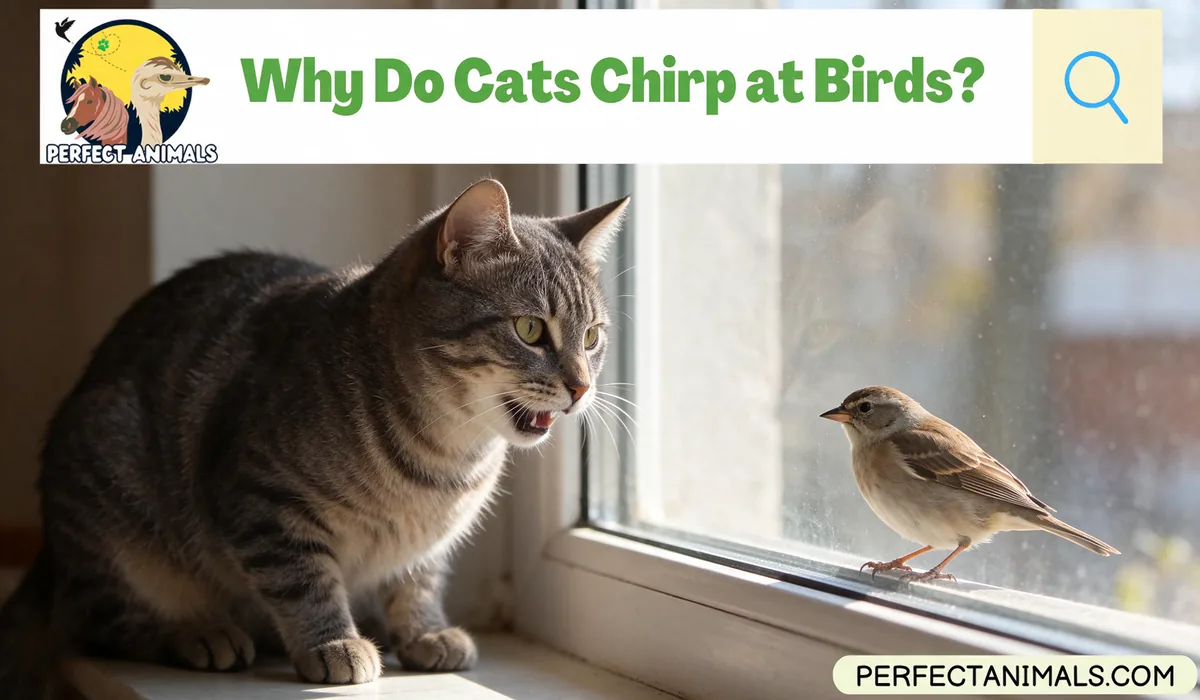
Cats may chirp at birds because seeing prey activates their predatory attention. The cat may become focused on movement, sound, and distance while watching the bird. If a closed window prevents the cat from reaching the prey, the excitement can be mixed with frustration.
Not every cat chirps, and the behavior is not limited to birds. Cats may also chirp at squirrels, insects, rodents, feather toys, or other fast-moving objects. The sound is common enough to have several names, including chirping, chattering, twittering, trilling, and chittering.
What does cat chirping sound like?
A chirp is usually a short, high-pitched sound that may resemble a bird’s call. Chattering can include quick clicking or repeated opening and closing of the mouth. Some cats make a sequence of chirps, while others produce a soft trill or a rapid, almost mechanical chatter.
The labels are informal, and owners may use them differently. Instead of focusing on the exact name, watch what the cat is doing. A cat that is alert at a window may crouch, stare, point its ears forward, widen its eyes, or swish its tail while making the sound.
1. Hunting instincts may be activated
Domestic cats still retain many behaviors associated with hunting. A bird hopping across a backyard or landing on a feeder provides movement and sound that can capture a cat’s attention. Chirping may appear during this highly focused state, especially when the cat is watching from indoors.
Hunting behavior includes more than the final capture. Stalking, tracking, watching, pouncing, and manipulating a toy can all be parts of the sequence. A cat may chirp even when it has no realistic opportunity to catch the bird because the visual and auditory stimulus is enough to trigger the response.
2. Excitement and frustration can happen together
A cat looking at a bird through a closed window may be excited because prey is nearby and frustrated because the barrier prevents access. Cats Protection describes this as one possible reason for chattering and chirping. The cat may want to pursue the animal, or it may simply be highly aroused by seeing something interesting in its territory.
Do not assume that a chirping cat is suffering simply because it cannot go outside. Check the rest of its behavior. If the cat can move away, eat normally, rest, and engage in play, the episode may be a short-lived response to stimulation. If the cat becomes agitated, repeatedly slams into the window, or cannot settle, reduce the visual trigger and provide another outlet.
3. Chirping can be a friendly social sound
Chirps and trills are not used only for prey. VCA describes chirping and trilling as friendly vocalizations that can greet people or signal interest. Hill’s Pet Nutrition also notes that cats may use these sounds for greeting, attention, acknowledgment, and approval.
Your cat may chirp when you enter the room, approach its food bowl, pick up a favorite toy, or begin a familiar routine. A friendly chirp often appears with relaxed social behavior, such as approaching you, rubbing against your legs, or holding the body loosely. The same cat can use a similar sound during a very different prey-focused moment.
4. Is your cat trying to imitate a bird?
People often say cats chirp at birds because they are copying them. This is possible as a behavioral theory, but it is not established fact. Cats Protection lists prey imitation among several proposed explanations, while VCA specifically notes that the idea is anecdotal and not backed by research.
It is more accurate to say that a cat’s chirping may occur when prey captures its attention and hunting motivation is active. Avoid presenting imitation as the reason every cat makes the sound. Animal behavior often has several contributing factors, and the same vocalization can serve different functions in different contexts.
5. Your cat may be reacting to an unreachable target
Indoor cats frequently chirp at wildlife outside windows because the glass creates a safe but frustrating boundary. The cat can see and hear the bird without being able to approach it. Outdoor cats may also chirp when prey is on the other side of a fence, high in a tree, or moving too quickly to catch.
If your cat becomes overly focused on a window, close the curtain or use an opaque film on the lower section for part of the day. You do not need to eliminate every view of wildlife, but you should give the cat a way to disengage. A high perch in another room, a quiet resting place, or a short play session can help shift attention.
What does your cat’s body language mean while chirping?
A cat crouching low with a fixed stare, tense shoulders, forward-pointing ears, wide pupils, and a twitching or swishing tail is probably highly focused on the animal outside. This posture may show excitement, anticipation, or frustration. It does not necessarily mean the cat is angry at you.
A cat chirping at a person may look different. It may stand upright, walk toward you, rub against furniture, blink slowly, or lift its tail. Body language can change quickly, so watch the entire episode rather than relying on the sound alone.
Should you stop a cat from chirping at birds?
Usually, no. Occasional chirping is a natural behavior and does not need to be corrected. You should step in if the cat is becoming distressed, damaging the window, trying to escape, or unable to settle after the bird leaves.
Use a toy to redirect the cat’s attention instead of grabbing or scolding it. A wand toy can provide a controlled opportunity to stalk, chase, and pounce. Let the cat catch the toy at the end of the game, then offer a quiet place to rest. Short interactive play sessions each day can provide a safe outlet for hunting behaviors.
How can you protect birds while keeping an indoor cat happy?
Keeping a cat indoors or using secure outdoor access protects the cat from traffic, fights, disease, and other hazards while also reducing hunting of wildlife. Window feeders should be positioned thoughtfully so birds do not repeatedly approach a window where a cat can strike the glass. Close curtains or move the feeder if your cat becomes intensely agitated.
Provide climbing shelves, puzzle feeders, hiding spaces, scratching posts, and rotating toys. Enrichment works best when it gives the cat choices and uses several senses. A feather wand can imitate the movement of prey, but supervise toys with strings or loose parts and store them safely afterward.
When is cat chirping a reason to call the vet?
Chirping at birds is usually not a medical problem when it is a familiar behavior and your cat otherwise seems well. However, a sudden change in vocalization deserves attention. Contact your veterinarian if your cat begins chirping or chattering much more than usual, makes sounds in unusual situations, or shows other changes such as hiding, reduced appetite, lethargy, pain, or difficulty breathing.
Do not confuse prey-focused chattering with a cat that is crying, yowling, or screaming in distress. A cat that vocalizes painfully, strains in the litter box, cannot urinate, or seems suddenly ill needs prompt veterinary care. The safest interpretation comes from the sound, body language, duration, and overall health together.
Is it normal if a cat never chirps?
Yes. Cats have individual vocal styles, and not all cats chirp or chatter. A quiet cat can still be interested in birds and can express excitement through staring, crouching, tail movement, or silent tracking. The absence of chirping does not mean your cat is unhappy or less predatory.
Other animal behaviors also depend on context. For example, cats knead blankets for comfort and other reasons, while dogs tilt their heads while processing sounds and information. One behavior rarely has one fixed meaning for every animal.
Bottom line: why do cats chirp at birds?
Cats chirp at birds because prey can activate their hunting attention, excitement, and frustration. Some cats also use chirps as friendly social sounds, and the popular idea that every cat is imitating a bird remains only a theory. Watch the whole body, give your cat safe play and enrichment, and reduce the window trigger if the cat becomes distressed.
Sources: Hill’s Pet Nutrition: What Is Cat Chirping?, Cats Protection: Why Do Cats Chatter and Chirp at Birds?, and VCA Animal Hospitals: Cat Chatter.

John Maloney, a passionate bird enthusiast since his childhood, has cultivated expertise in bird care and habitat conservation. Holding an MS in Wildlife Biology from the University of Florida, John has conducted significant research on endangered bird species and their ecosystems.