Why Do Pigeons Bob Their Heads When They Walk?
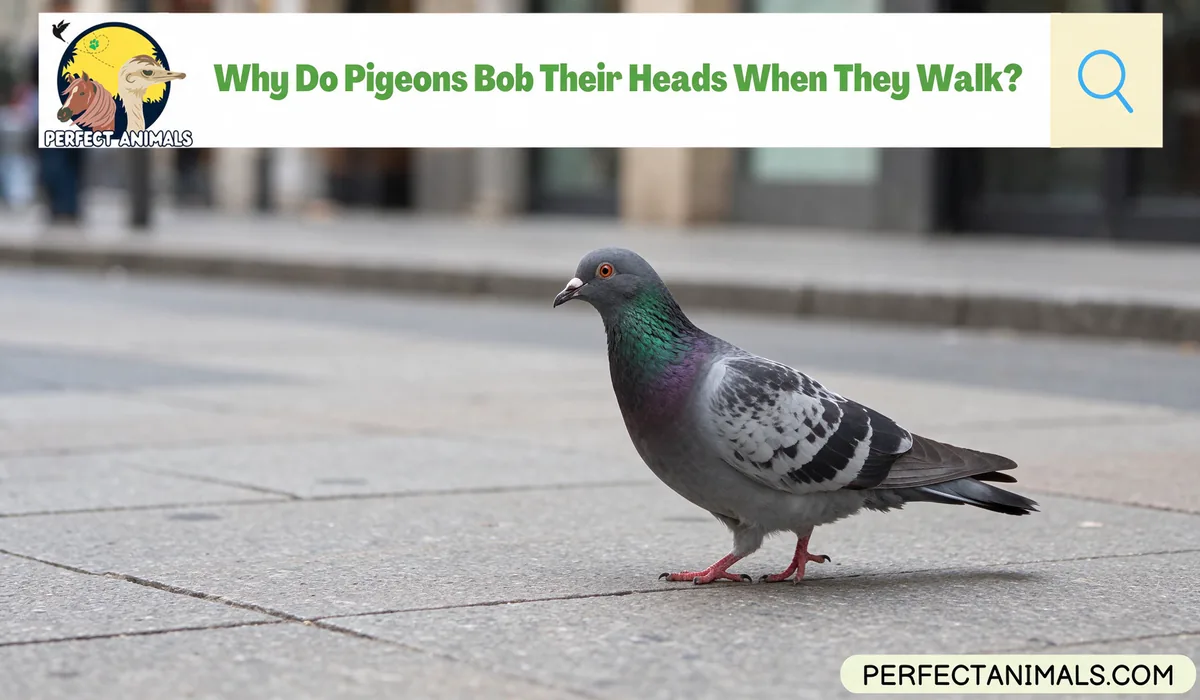
If you have watched pigeons walking across a city sidewalk, you have probably noticed their heads moving forward and back with every few steps. The motion looks like a tiny dance, but why do pigeons bob their heads when they walk? The leading explanation is visual: the movement helps pigeons keep their view of the world stable while their bodies are moving.
What looks like a simple bob is actually a quick sequence of a forward thrust and a brief hold. Understanding that sequence explains why pigeons do it, why some other birds show similar behavior, and why a pigeon may stop bobbing on a moving treadmill.
Why do pigeons bob their heads when they walk?
Most evidence suggests that pigeons bob—or more accurately, thrust and hold—their heads to stabilize their vision. A pigeon’s body moves forward as it walks, but its head briefly stays in place relative to the surrounding scene. That short pause helps keep the image from smearing across the bird’s retina.
The Library of Congress describes this as the prevailing explanation for head-bobbing in pigeons. The behavior is not simply a funny habit and is not best explained as a rhythmic nod. It is a way of managing visual information while walking through a changing environment.
Are pigeons really bobbing their heads?
Slow-motion footage shows that the familiar “bob” has two main parts. First, the pigeon thrusts its head forward. Then it holds the head relatively still in space while the body catches up. To an observer, the rapid repetition looks like the head is moving backward and forward.
A peer-reviewed review indexed by PubMed calls these the thrust phase and the hold phase. During the hold phase, the head moves backward in relation to the pigeon’s body but remains more stable in relation to the outside world. The legs and head movements are synchronized as the bird walks.
How does head-bobbing help a pigeon see?
Imagine trying to read a sign while riding over a bumpy sidewalk. If the sign’s image slid continuously across your field of view, details would be harder to process. A pigeon’s hold phase gives its visual system a brief stable view before the next thrust.
That stability may help a pigeon judge nearby objects, notice food on the ground, and monitor potential threats. It does not mean that every head movement has one perfectly proven purpose. Scientists have proposed visual stabilization, depth perception, and other functions, but the evidence most strongly supports the role of keeping the scene visually steady.
Humans solve a similar visual problem in a different way. Instead of repeatedly thrusting the head while walking, we rely heavily on rapid eye movements and brief periods when the eyes hold an image steady. Pigeons can move their eyes, too, but their walking head movement provides another way to reduce visual blur.
What did the pigeon treadmill experiment show?
One of the best-known experiments placed a pigeon on a treadmill while the surrounding visual scene remained relatively stationary. When the pigeon walked at the same speed as the treadmill, its surroundings did not slide backward in the usual way. The pigeon’s head did not show the normal bobbing pattern.
This result helped researchers connect the behavior to visual stimulation rather than movement alone. If head-bobbing were only a balance mechanism, the pigeon would be expected to do it whenever its legs moved. Instead, the visual relationship between the bird and its surroundings appears to matter.
Do all birds bob their heads while walking?
No. The behavior occurs in several groups of ground-walking birds, but it is not universal. The Library of Congress gives chickens, cranes, magpies, and quails as examples of birds that can show head-bobbing. Herons and some other wading birds may also use a slower head-thrusting motion while positioning themselves near prey.
Many small songbirds, including sparrows and finches, usually move by hopping rather than walking in the same way. Ducks, owls, and penguins are examples of birds that do not typically show the familiar pigeon-like motion. Differences in body shape, gait, habitat, and feeding behavior may help explain why some birds use the strategy and others do not.
Why do pigeons bob more on some surfaces or in some situations?
Head-bobbing is connected to how the bird moves through its visual environment, so the behavior can change with the setting. A pigeon walking across an open sidewalk may show the motion clearly. A bird standing still, moving through a visually uniform area, or riding on a surface that keeps the surrounding scene nearly stable may show less of it.
The behavior can also be difficult to see when a pigeon is moving quickly, turning, pecking, or using a different gait. Not every forward head movement is a complete walking cycle, and a short video may make the motion look more exaggerated or more irregular than it really is.
Does head-bobbing mean a pigeon is sick?
Ordinary head-bobbing while a pigeon walks is normal behavior and is not, by itself, a sign of illness. The more important warning signs are problems such as inability to stand or fly, obvious injury, severe weakness, trouble breathing, or unusual lack of response.
If you find an injured or grounded wild pigeon, avoid handling it unless a licensed wildlife rehabilitator advises you to do so. Keep pets away and contact a local wildlife professional for instructions. Do not assume that offering food or water is always safe for an injured bird.
Why do pigeons bob their heads? The short answer
Pigeons appear to bob their heads because they thrust the head forward and then hold it steady while the body catches up. That hold phase helps stabilize the bird’s view and may reduce motion blur as it walks. The behavior is best understood as a visual strategy, not a meaningless dance or a universal feature of every bird.
For more bird behavior, read our guides to why birds fluff up their feathers, birds with red heads, and what it means when a bird hits your window.
Sources
- Library of Congress: Why Do Pigeons Bob Their Heads When They Walk?
- PubMed: Head-bobbing of walking birds
- Live Science: Why do pigeons bob their heads?

John Maloney, a passionate bird enthusiast since his childhood, has cultivated expertise in bird care and habitat conservation. Holding an MS in Wildlife Biology from the University of Florida, John has conducted significant research on endangered bird species and their ecosystems.