Why Do Owls Bob Their Heads? Motion Parallax and Young Owls Explained
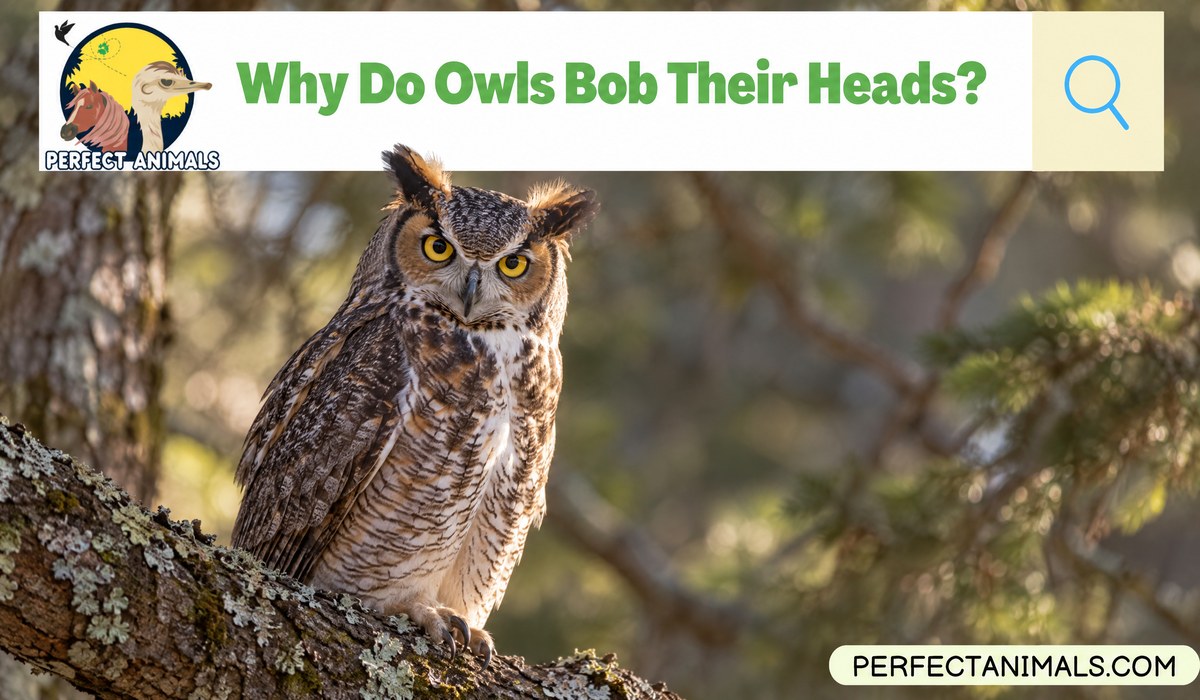
Why do owls bob their heads? Owls bob, sway, and turn their heads to gather visual information. Because an owl’s large forward-facing eyes are held relatively firmly in its skull, the bird cannot shift its eyes around as freely as a person can. Moving the head changes the view of an object and helps the owl judge where it is in space.
The short answer is not that an owl is dizzy, trying to hypnotize prey, or sending a mystical signal. Head movement is mainly part of the bird’s visual system, although different movements can have different causes.
How head-bobbing helps an owl see depth
When an owl moves its head from side to side, the scene shifts slightly across its field of view. The brain can compare those changing views to estimate distance and position. This visual process is often described as motion parallax.
Audubon’s explanation of owl head-bobbing notes that the movement helps an owl judge the location of an object. The Owl Research Institute also describes motion parallax as an important part of how young owls learn to interpret the world around them. These observations are especially useful when an owl is looking at prey, a landing spot, or an unfamiliar object.
Why owls turn their heads so far
Owls can turn their heads much farther than people can, but the popular idea that they can rotate their heads a full 360 degrees is wrong. Their unusual neck structure and blood-vessel adaptations allow a very large range of motion without cutting off the brain’s blood supply.
Head turning also helps an owl redirect its forward-facing field of view. The eyes provide excellent depth perception, but they do not swivel in the same way human eyes do. Turning the head lets the owl examine more of its surroundings while keeping its body still.
Why do baby owls bob their heads?
Young owls may bob or sway more noticeably than adults because they are still learning how visual information relates to distance. An exaggerated movement can help a developing bird compare the apparent motion of nearby and distant objects.
That does not mean every head movement has exactly the same explanation. A young owl may also move its head while watching something interesting, orienting toward a sound, or reacting to a new situation.
Is head-bobbing the same as head-turning?
Not quite. A repeated side-to-side bob or sway is often associated with gathering visual depth information. A quick turn may simply help an owl look in another direction. Owls can also make head movements while locating sounds, watching a possible threat, or tracking movement.
It is best to read the entire situation rather than assign one meaning to every movement. A wild owl that keeps its distance is behaving normally; it should not be approached, fed, or handled.
What does owl head-bobbing not mean?
- It does not prove that an owl is angry or aggressive.
- It is not reliable evidence of a spiritual message.
- It does not mean the owl is trying to hypnotize a person.
- It is not always a sign that the bird is sick.
However, an owl that is visibly injured, trapped, or unable to fly may need help from a licensed wildlife rehabilitator. Keep people and pets back and contact a local wildlife rescue organization rather than trying to catch the bird yourself.
Related owl questions
If you want to learn more about owl behavior, read our guide to why owls hoot and our regional overview of owls in Illinois. Head movement, vocalization, and habitat are different parts of owl biology, so one behavior should not be used to explain all of the others.
Bottom line
Owls bob their heads because movement helps them interpret visual information. Motion parallax gives the brain changing views that can help estimate distance, while head turning lets the owl redirect its view despite relatively fixed eyes. Young owls may make the behavior look more dramatic as they learn to navigate their surroundings.
Sources: National Audubon Society: Why Do Owls Bob Their Heads? and Owl Research Institute: motion parallax in young owls.

Larissa Adler, an Ornithology graduate from Charles Sturt University, is an avid birdwatcher with a passion for avian behavior and ecology. With extensive fieldwork experience studying bird migration patterns and nesting behaviors, Larissa brings a practical and insightful perspective to our bird-related articles.